Bioavailability: Maximize Supplement Efficacy Scientifically
Advertisements
Understanding and applying scientific principles of bioavailability is essential to maximize supplement efficacy, potentially boosting nutrient absorption and utilization by up to 30%.
Have you ever wondered why some supplements seem to work wonders while others fall flat? The answer often lies in bioavailability, a critical yet frequently misunderstood concept. This article delves into the science behind how your body absorbs and utilizes nutrients, providing actionable insights to potentially boost your supplement efficacy by up to 30%.
The foundational science of bioavailability
Bioavailability refers to the proportion of a drug or other substance that enters the circulation when introduced into the body and so is able to have an active effect. In simpler terms, it's how much of a nutrient you ingest actually gets absorbed and used by your body. It's not just about what you take, but what your body can truly access.
Several factors influence this crucial process, from the form of the nutrient itself to your individual physiology. Understanding these fundamentals is the first step toward optimizing your supplement regimen and ensuring you're getting the most out out of every dose.
Advertisements
Defining key terms: absorption, distribution, metabolism, excretion (ADME)
To fully grasp bioavailability, it's helpful to break down the journey a nutrient takes within your body. This is often summarized by the acronym ADME, which stands for:
- Absorption: The process by which nutrients pass from the site of administration (usually the gut) into the bloodstream.
- Distribution: The reversible transfer of a nutrient from the bloodstream to other tissues and organs in the body.
- Metabolism: The biochemical modification of nutrients by enzymes, primarily in the liver, which can alter their activity or facilitate their excretion.
- Excretion: The removal of nutrients and their metabolites from the body, typically through urine or feces.
Each stage of ADME can impact how much of a supplement ultimately reaches its target cells and performs its intended function. For instance, if a nutrient is poorly absorbed, it won't even make it to the distribution phase in significant amounts.
In conclusion, bioavailability is a complex interplay of physiological processes. By recognizing that not all ingested nutrients are equally available for your body's use, we can begin to explore strategies to enhance this availability and, consequently, the effectiveness of our supplements.
Factors impacting nutrient absorption
The journey of a nutrient from your supplement pill to your cells is fraught with potential roadblocks. Numerous factors, both intrinsic to the nutrient and external to it, can significantly influence how well it's absorbed and utilized. Identifying these factors is key to making informed supplement choices.
Understanding these influences allows us to select supplements formulated for better absorption and to pair them strategically with other substances or at specific times to maximize their impact.
Nutrient form and chemical structure
The chemical form of a nutrient is perhaps the most critical determinant of its bioavailability. For example, some minerals are much better absorbed when chelated, meaning they are bound to an amino acid. This makes them more stable and less likely to react with other compounds in the gut, which could impede absorption.
Consider magnesium: magnesium citrate often has higher bioavailability than magnesium oxide because citrate is more soluble and more easily absorbed. Similarly, vitamin D3 (cholecalciferol) is generally more effective at raising blood vitamin D levels than vitamin D2 (ergocalciferol).
Digestive health and gut microbiome
Your digestive system is the primary gateway for nutrient absorption. A healthy gut lining and a balanced gut microbiome are essential. Conditions like leaky gut syndrome, inflammatory bowel disease, or even simple indigestion can compromise absorption. The trillions of bacteria in your gut also play a significant role, helping to break down certain compounds and synthesize others, influencing the bioavailability of various nutrients, including B vitamins and vitamin K.
Furthermore, stomach acid levels are crucial for breaking down food and supplements, releasing nutrients for absorption. Individuals with low stomach acid (hypochlorhydria), often associated with aging or certain medications, may experience reduced absorption of minerals like iron and calcium, as well as vitamin B12.
In summary, optimizing nutrient absorption requires attention to both the form of the supplement and the health of your digestive system. A holistic approach that considers both aspects will yield the best results for maximizing supplement efficacy.
Enhancing bioavailability: scientific strategies
Once we understand the challenges to nutrient absorption, we can implement science-backed strategies to overcome them. These methods aim to protect nutrients from degradation, improve their solubility, or facilitate their transport across biological membranes, ultimately increasing the amount that reaches systemic circulation.
By employing these techniques, supplement manufacturers and informed consumers can significantly boost the effectiveness of various health compounds, making every dose count more.
Liposomal encapsulation technology
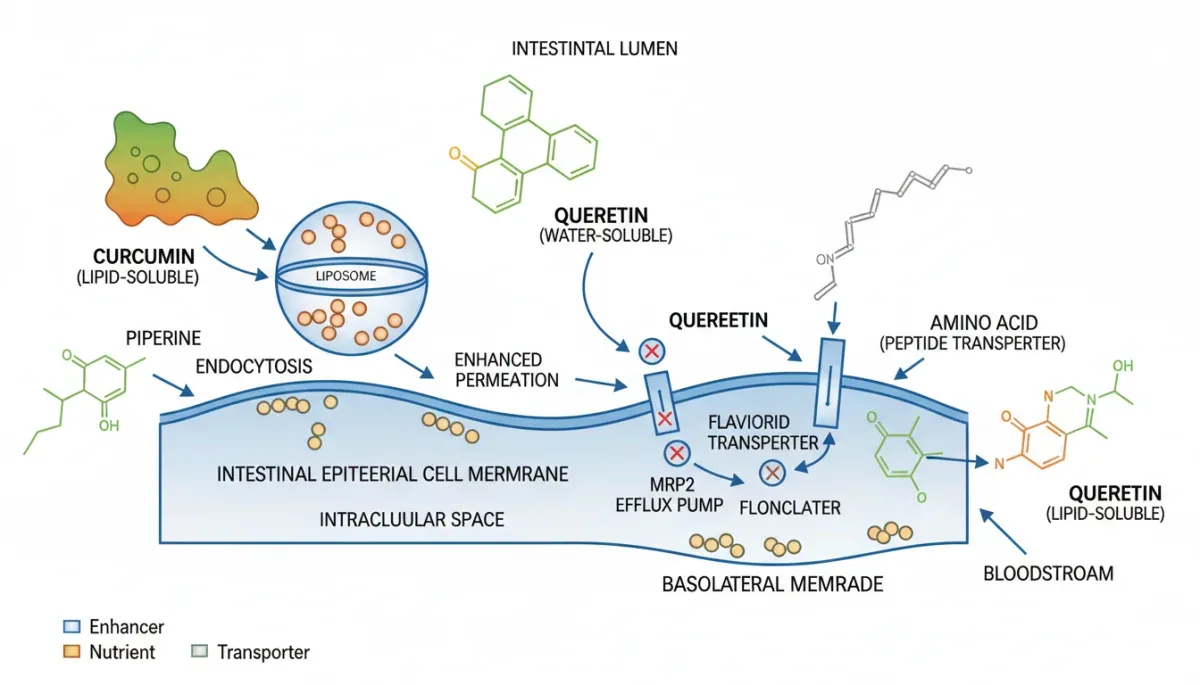
Liposomal delivery systems are revolutionizing supplement efficacy, particularly for nutrients that are poorly absorbed or easily degraded in the digestive tract. Liposomes are tiny, spherical vesicles made from phospholipids, similar to the membranes of our own cells.
- Protection: They encapsulate nutrients, protecting them from stomach acid, digestive enzymes, and bile salts.
- Enhanced Absorption: Their lipid-based structure allows them to be absorbed more readily through the intestinal wall and directly into the bloodstream.
- Targeted Delivery: In some cases, liposomes can help deliver nutrients directly to cells, bypassing some metabolic processes.
This technology is particularly effective for vitamin C, glutathione, and curcumin, where traditional oral forms often suffer from low bioavailability.
Co-administration with absorption enhancers
Certain natural compounds can act as "bioavailability enhancers" when taken alongside other supplements. These enhancers work through various mechanisms, such as increasing intestinal permeability, inhibiting metabolic enzymes, or improving solubility.
- Piperine (from black pepper): Known to enhance the absorption of curcumin, coenzyme Q10, and selenium by inhibiting certain enzymes in the liver and intestines that metabolize these compounds.
- Quercetin: Can improve the bioavailability of resveratrol by inhibiting its metabolism.
- Healthy Fats: Fat-soluble vitamins (A, D, E, K) and compounds like curcumin are best absorbed when consumed with dietary fats.
Careful pairing of supplements with these enhancers can lead to a synergistic effect, dramatically increasing the amount of active ingredient that reaches your system.
Implementing these scientific strategies, whether through choosing liposomal formulations or consciously pairing supplements with enhancers, represents a significant step towards optimizing your nutrient intake and achieving greater health benefits.

Specific nutrients and their bioavailability challenges
Not all nutrients are created equal when it comes to how easily they are absorbed and utilized by the body. Many popular supplements face significant bioavailability hurdles, making it crucial to understand these challenges to select the most effective forms.
Recognizing these specific issues allows consumers to make smarter choices, ensuring their investment in supplements translates into tangible health improvements.
Curcumin (from turmeric)
Curcumin, the active compound in turmeric, is renowned for its anti-inflammatory and antioxidant properties. However, its therapeutic potential is often limited by its extremely poor bioavailability. It is poorly soluble in water, rapidly metabolized, and quickly excreted from the body.
To overcome this, several enhanced forms have emerged:
- Liposomal curcumin: Encapsulating curcumin in liposomes significantly improves its absorption.
- Curcumin with piperine: Piperine, an extract from black pepper, inhibits enzymes that metabolize curcumin, thereby increasing its systemic availability.
- Micellar formulations: Using micelle technology to create highly soluble curcumin.
Magnesium
Magnesium is vital for hundreds of bodily functions, yet many people are deficient. The bioavailability of magnesium supplements varies widely depending on the form:
- High bioavailability forms: Magnesium citrate, glycinate, malate, and taurate are generally well-absorbed due to their solubility and chelated nature.
- Low bioavailability forms: Magnesium oxide, while containing a high percentage of elemental magnesium, is poorly absorbed and often used for its laxative effect rather than systemic supplementation.
Choosing the right form of magnesium is essential for addressing deficiencies and supporting overall health.
Understanding the unique bioavailability challenges of individual nutrients empowers you to select superior supplement formulations, ensuring that you receive the maximum possible benefit from your daily regimen.
Timing and dosage for optimal absorption
Beyond the form of the nutrient itself and the presence of enhancers, the timing of supplement intake and the specific dosage can play a critical role in maximizing bioavailability. Your body's physiological state changes throughout the day, influencing how effectively it processes ingested substances.
Strategic timing and appropriate dosing can prevent nutrient interactions, minimize degradation, and align with your body's natural rhythms for better absorption.
Empty stomach vs. with food
Some supplements are best taken on an empty stomach, while others require food for optimal absorption:
- Empty stomach: Many probiotics, certain amino acids (like L-tyrosine), and some enzymes are best taken without food to avoid interaction with digestive processes or competition for absorption pathways.
- With food: Fat-soluble vitamins (A, D, E, K), coenzyme Q10, and curcumin benefit from being taken with a meal, especially one containing healthy fats, which aid in their solubilization and absorption. Minerals like iron are often better tolerated with food to reduce gastrointestinal upset, though some forms are absorbed better on an empty stomach.
Splitting doses and nutrient interactions
For some nutrients, taking a single large dose might not be as effective as splitting it into smaller, more frequent doses throughout the day. This is particularly true for water-soluble vitamins like vitamin C, where the body can only absorb a certain amount at once, and the rest is excreted.
Furthermore, be mindful of potential nutrient interactions. For example, calcium can interfere with the absorption of iron and zinc, so it's often recommended to take these minerals at different times. Similarly, magnesium and calcium can compete for absorption, making separate dosing advisable for high amounts of both.
By carefully considering when and how much of a supplement you take, you can significantly enhance its bioavailability and ensure your body is primed to absorb and utilize its beneficial compounds effectively.
Personalized approaches to bioavailability
While general scientific principles provide a strong foundation, the reality is that bioavailability can be highly individual. What works perfectly for one person might not be as effective for another, due to unique genetic predispositions, lifestyle factors, and underlying health conditions. A personalized approach is often the most effective way to truly maximize supplement efficacy.
Embracing personalization means moving beyond a one-size-fits-all mentality and tailoring your supplement strategy to your specific needs and biological responses.
Genetic variations and enzyme activity
Our genes play a significant role in how our bodies process nutrients. Polymorphisms in genes encoding digestive enzymes, transport proteins, or metabolic enzymes can directly impact bioavailability. For example, some individuals have genetic variations that affect their ability to convert certain forms of B vitamins into their active forms, making supplements with pre-activated forms (e.g., methylfolate instead of folic acid) more bioavailable and effective for them.
Similarly, genetic differences in liver detoxification pathways can influence how quickly certain compounds are metabolized and eliminated, affecting their systemic availability.
Lifestyle, diet, and individual health status
Your lifestyle and overall health are powerful determinants of bioavailability:
- Diet: A diet rich in whole foods, fiber, and diverse plant compounds supports gut health, which is fundamental for absorption. Processed foods, on the other hand, can impair digestive function.
- Stress: Chronic stress can negatively impact digestion and nutrient absorption.
- Medications: Certain medications can interfere with nutrient absorption or increase their excretion. For example, proton pump inhibitors can reduce stomach acid, impairing the absorption of B12 and minerals.
- Age: As we age, stomach acid production often decreases, and digestive enzyme activity may decline, impacting the absorption of many nutrients.
Consulting with a healthcare professional or a registered dietitian can provide invaluable guidance in navigating these personalized factors. They can help identify specific deficiencies, assess potential interactions, and recommend the most bioavailable forms and strategies tailored to your unique physiological profile.
Ultimately, a personalized approach to bioavailability, considering both genetic factors and lifestyle influences, is the most robust path to truly optimizing your supplement regimen and achieving the best possible health outcomes.
| Key Bioavailability Principle | Brief Description |
|---|---|
| Nutrient Form Selection | Choose highly absorbable forms (e.g., chelated minerals, active vitamin forms) over less bioavailable options. |
| Absorption Enhancers | Pair supplements with compounds like piperine or healthy fats to boost uptake and utilization. |
| Delivery Systems | Utilize advanced technologies such as liposomal encapsulation for superior protection and absorption. |
| Strategic Timing | Take supplements at optimal times (e.g., with food, empty stomach) and consider splitting doses for better efficacy. |
Frequently asked questions about bioavailability
What does bioavailability mean for my supplements?▼Bioavailability refers to the percentage of a nutrient from a supplement that is actually absorbed and used by your body. It's crucial because a supplement with high bioavailability means more of the active ingredient reaches your bloodstream and target cells, leading to greater effectiveness, regardless of the stated dosage on the label.
How can I tell if a supplement has good bioavailability?▼Look for specific forms of nutrients known for high absorption (e.g., magnesium glycinate over magnesium oxide). Also, consider advanced delivery systems like liposomal encapsulation. Reputable brands often provide information or studies on the bioavailability of their specific formulations. Researching the nutrient's chemical form is key.
Do all nutrients have the same bioavailability challenges?▼No, bioavailability challenges vary significantly between different nutrients. For example, fat-soluble vitamins require dietary fat for absorption, while some minerals are sensitive to stomach acid levels. Compounds like curcumin are notoriously poorly absorbed on their own, necessitating specific enhancement strategies like piperine or liposomal delivery for efficacy.
Can my diet influence supplement bioavailability?▼Absolutely. Your overall diet profoundly impacts supplement bioavailability. A healthy, balanced diet supports optimal digestive function, which is critical for absorption. Conversely, a poor diet can hinder it. Consuming certain supplements with specific foods (e.g., fat-soluble vitamins with healthy fats) can also significantly boost their absorption.
Is higher bioavailability always better?▼Generally, yes, higher bioavailability is desirable as it means more of the active compound reaches its target. However, it's essential to consider the specific nutrient and your individual needs. For example, some low-bioavailability forms of magnesium are intentionally used for their laxative effect. Always consult with a healthcare professional to tailor your supplement choices.
Conclusion
Understanding and actively applying the scientific principles of bioavailability is not merely an academic exercise; it's a practical strategy to significantly enhance the efficacy of your supplements and, by extension, your overall health. From selecting optimal nutrient forms and leveraging advanced delivery systems to strategically timing your intake and personalizing your approach, each step contributes to maximizing how your body absorbs and utilizes vital compounds. By making informed choices, you can ensure that your investment in supplements truly translates into tangible health benefits, potentially boosting their impact by up to 30%.